Trainings
Trainings
Continuous capacity building
 The cotton companies involved with Cotton made in Africa offer agricultural and business trainings to participating smallholder farmers. This helps them to grow cotton in a manner that is more efficient and eco-friendly, while still being profitable.
Training is always adapted to regional conditions and the needs of the respective smallholder farmers. Cotton made in Africa often makes use of picture blocks that tell simple stories in pictures to illustrate the content covered in training sessions. These help farmers to remember the information even if they cannot read and write. In addition to technical aspects of agriculture, sessions cover topics such as health protection or business fundamentals. Training sessions that cotton companies deliver through a training cascade to their associated farmers follow and keep pace with the seasonal cotton-growing cycle.
The cotton companies involved with Cotton made in Africa offer agricultural and business trainings to participating smallholder farmers. This helps them to grow cotton in a manner that is more efficient and eco-friendly, while still being profitable.
Training is always adapted to regional conditions and the needs of the respective smallholder farmers. Cotton made in Africa often makes use of picture blocks that tell simple stories in pictures to illustrate the content covered in training sessions. These help farmers to remember the information even if they cannot read and write. In addition to technical aspects of agriculture, sessions cover topics such as health protection or business fundamentals. Training sessions that cotton companies deliver through a training cascade to their associated farmers follow and keep pace with the seasonal cotton-growing cycle.Agricultural Trainings
Cotton farming in Africa relies on smallholder farmers who cultivate relatively small fields primarily by hand. The agricultural training sessions teach them how to manage their land in a more efficient and environmentally-friendly way. Key topics include: good agricultural practices, maintaining soil fertility (for example through crop rotation), and the use of botanical pesticides that the farmers can produce for themselves. A major challenge facing smallholder cotton farmers is a lack of knowledge on how to handle pesticides. Pesticides are often used, stored, and disposed of improperly, creating a dangerous situation for both people and the environment. For this reason, Cotton made in Africa strictly regulates pesticide use, prohibiting all pesticides listed in the Rotterdam Convention on the Prior Informed Consent Procedure for Certain Hazardous Chemicals and Pesticides in International Trade1 (PIC Convention) or in the Stockholm Convention on Persistent Organic Pollutants2 (POP Convention). Pesticides classified as highly or extremely hazardous by the World Health Organization (WHO) are also banned3 (WHO Class Ia/b).Running a Farm as a Business
Business Fundamentals
CmiA verified cotton companies also teach smallholder farmers basics business skills to make it easier for them to run their agricultural small businesses. What are the projected operating costs, and what sort of yields and revenue can we reasonably expect? Would a loan be useful, or would it exceed our current capabilities? How can we afford the school fees for our children? How do we plan our household and farm budgets? Cotton made in Africa has developed training materials in local languages so that farmers are able to run their businesses more professionally and productively.Number of participants in trainings per topics:
(Status 2021)851.590BASIC AGRICULTURE TECHNIQUES593.953CONSERVATION TECHNIQUE TO IMPROVE SOIL FERTILITY665.769INTEGRATED PEST MANAGEMENT (IPM)682.682PROPER USE AND STORAGE OF PESTICIDES728.214CMIA CHILD LABOR CRITERIA TRAINING, GENDER, HIV67.876BUSINESS SKILLS472.587POST HARVEST HANDLING AND GRADING (INCL. GOOD MANAGEMENT PRACTISE FOR HARVEST AND STORAGE OF SEED COTTON)26.529OTHER TRAINING TOPICS“Before CmiA, I used to plant the cotton haphazardly, but now I know about good agricultural practices.”
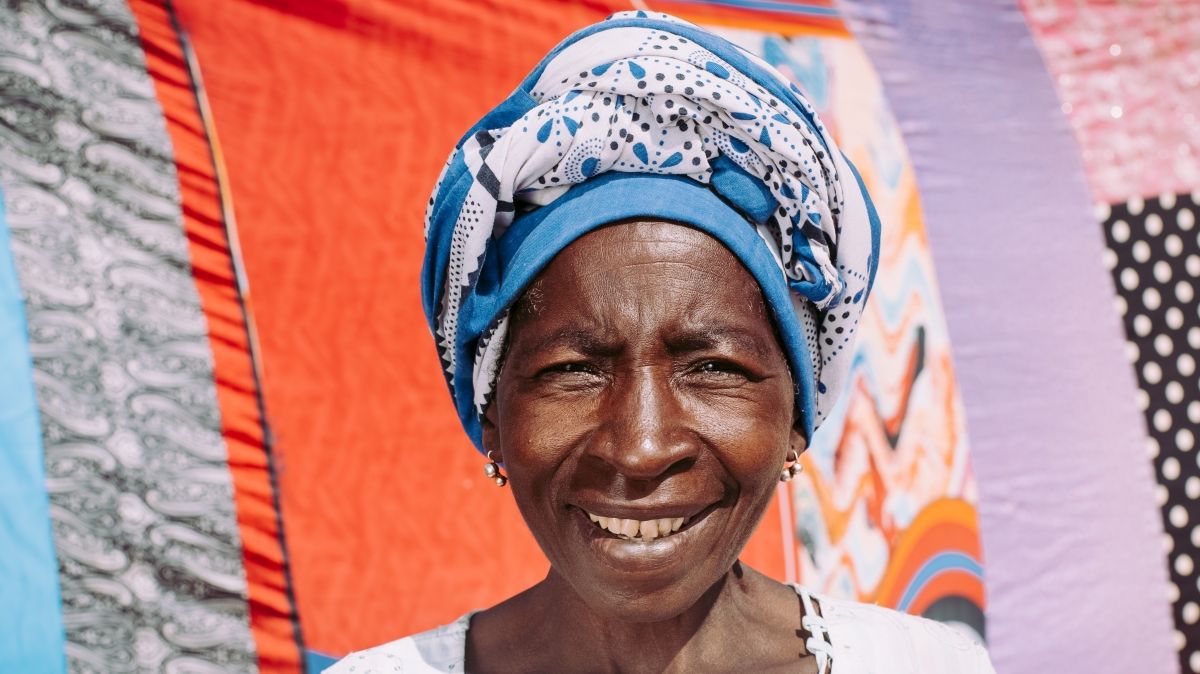 <strong>MIRIAM MUHINDO </strong>, a cotton farmer, from Uganda
Smart Farming, Example 1: Good Agricultural Practices (GAP)
The training sessions demonstrate good agricultural practices to cotton farmers in simple and easily comprehensible ways, for example through the five-finger principle:Timely and Proper Field Preparation As a first step, smallholder farmers learn that they need to prepare their fields at the right time and in a certain way. For example, fields should be prepared for the next season immediately after a cotton harvest. In addition, the same parcel of land cannot always be used for cotton. Crop rotation ensures that soil fertility is maintained, by planting different crops from one season to the next. In order to minimise the erosion of nutrient-rich soil caused by ploughing, the farmers are also taught how to work the soil only minimally post-harvest.Planting Early The sowing season starts when the regularly recurring rains begin. To optimise the use of their fields, lines are strung to mark the rows, helping farmers orientate themselves when planting.Suitable Crop Populations Optimal crop density is also important, which means farmers must avoid sowing too many or too few cotton seeds; otherwise, the fields may need to be thinned, or the planting may have to be supplemented.Continuous Weeding In subsequent months on the planting calendar, weeds must be properly removed on a daily basis.Pest Control The last point addresses pest control and the proper application of permitted pesticides, when necessary, to protect the harvest from pests in an economic manner.Smart Farming, Example 2: Integrated Production and Pest Management (IPPM)
Integrated Production and Pest Management (IPPM) plays an important role in the training of smallholder farmers.Examples of IPPM Measures
Organic Seed Treatment
Before cotton seeds are planted, they can be treated with cow manure, which contains numerous nutrients that promote germination and that offer optimal growing conditions for young cotton plants.Using Molasses Traps:
Early in the planting season, cotton farmers set up molasses traps. Molasses traps are filled containers, often empty five-litre cooking-oil canisters, with a mixture of water and molasses, which they tie to strong branches at multiple places on the field. The molasses, a by-product of sugar production, attracts bollworm moths. Since the trapped moths cannot lay any eggs, this reduces the impact the caterpillars of the bollworms can have right from the start.Plant-Based Pest Management
CmiA does not restrict itself to synthetic chemical pesticides to protect cotton plants against pests. Local plants that repel certain pests are also used, for example neem leaves and thorn apples (solanum). Neem leaves are plucked from surrounding areas, crushed while fresh, and left to steep in water for at least a day. The resulting brew is subsequently filtered and diluted with water before being sprayed on the infested cotton plants. Thorn apples are also gathered from surrounding areas, but only after the cotton season, when they are ripe. They are then dried and later ground up to create solanum powder, which can be mixed with water and sprayed onto the cotton fields when necessary.Natural Fertiliser
The training also addresses a variety of ways to supply the cotton plants with sufficient nutrients using local resources: establishing compost heaps, applying diluted cow urine, or producing liquid manure from dung and plant material.The Utility of Natural Pesticides and Fertilisers
Organic pesticides and natural fertilisers are examples of environmentally friendly and cost-efficient measures contributing to sustainable agriculture. The organic pesticides and fertilisers used provide an environmentally friendly alternative that is easy to produce: The necessary ingredients can be found all around the villages and cotton fields, free of charge, and can be processed by local smallholder farmers themselves using simple machines and household utensils. Expenditure on chemical pesticides and synthetic fertilisers can also be reduced. This benefit both people and nature.Smart Farming, Example 3: Safety Training for Handling Pesticides
Key considerations for the safe use of permitted pesticides include applying the pesticide properly, wearing protective clothing, storing the pesticide correctly, and disposing of the empty containers in the right way. Please find more information about the use of pesticides in chapter Principles and Criteria.
Downloads
Welcome to the download area! Here you can find a small overview of the Cotton made in Africa training material. For further material, please contact us:Training material
CmiA Picture Block - Biochar / Pit Hole
CmiA Picture Block Biochar
Training material CmiA against harassment
Training material CmiA against child labour Amharic
Training material CmiA against child labour Chichewa
Training material CmiA against child labour English
Training material CmiA against child labour Portuguese English West Ghana
Training material CmiA against child labour French
Training material CmiA against child labour Portuguese
Training material CmiA against child labour Swahali
Gender Picture Block COMPACI 2016 English
CmiA Soil Assessment Guide 2023
CMIA SOIL ASSESSMENT FIELD GUIDANCE 2023
- CMIA_Picture_Block_DINA3_Eng_251218_compressed
- CmiA_Picture Block Biochar_2023_EN
- CmiA_Harassment Poster_EN
- Training-material-CmiA-against-childlabour-Amharic
- Training-material-CmiA-against-childlabour-Chichewa
- Training-material-CmiA-against-childlabour-English
- Training-material-CmiA-against-childlabour-Portuguese-English-West-Ghana
- Training-material-CmiA-against-childlabour-French
- Training-material-CmiA-against-childlabour-Portuguese
- Training-material-CmiA-against-childlabour-Swahali
- Gender-Picture-Block-COMPACI-2016-English
- CmiA_SoilAssessmentGuide_2023
- CmiA_SoilAssessmentFieldGuidance_2023
This might also interest you